
AI agents
AI agent development services
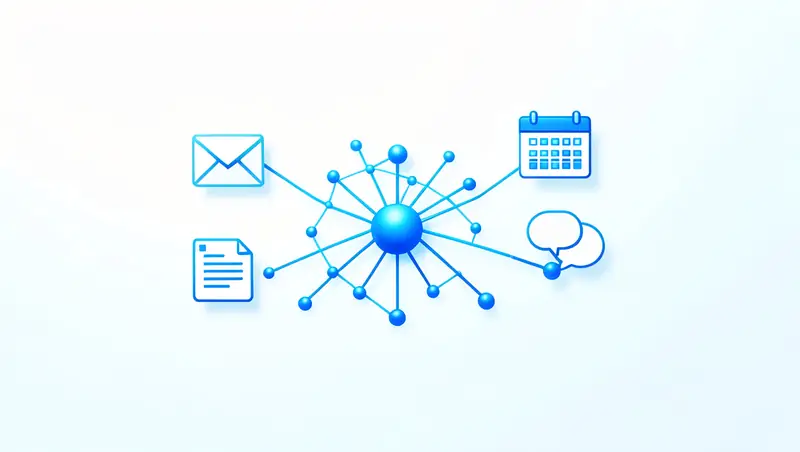
Our AI agent development service is for US businesses that want software to handle multi-step work on its own, not just answer questions. We build custom AI agents that read your emails, documents and records, decide what to do next, and act inside the tools your team already uses, with a person approving anything that matters.
Get a free proposal
Tell us what you need. A consultant replies within one business day.
Quick answer
What is AI agent development?
AI agent development is the work of building software that uses a large language model to plan and carry out multi-step tasks, such as reading emails, checking rules, updating records and drafting replies. Unlike a chatbot, an AI agent does work inside your existing tools and hands off to a person when it is unsure or a decision matters.
- An AI agent plans and completes multi-step tasks, while a chatbot mainly answers questions.
- Good first agents sit between an inbox or form and a system of record.
- A focused agent connected to two or three tools typically ships in two to four weeks.
- Projects start with a free review, then a fixed price and a staged plan.
01
What is AI agent development?
An AI agent is a program that uses a large language model to plan and carry out a task across several steps. It can look something up, compare it against your rules, write a draft, update a record and hand off to a person when it is unsure. A chatbot talks. An agent does work.
AI agent development is the process of designing that agent around one real job, giving it access to the right data and tools, and putting guardrails around what it is allowed to do. The model is only one part. Most of the effort goes into the integrations, the instructions, the test cases and the review step.
02
Custom AI agents we build
We start from a task your team repeats every day and can describe clearly. Good first agents usually sit between an inbox or form and a system of record, where someone currently reads, decides and retypes.
Typical custom AI agents include:
- Inbox triage agents that classify incoming email, pull out the details and route each message to the right person or queue
- Research agents that gather information on a company, supplier or prospect and write a short brief in a fixed format
- Document agents that read invoices, contracts or applications and check them against your rules before anything is entered
- Reporting agents that pull numbers from several systems and draft a weekly or monthly status report
- Back-office agents that update your CRM, project tool or spreadsheet after a call, meeting or form submission
WHAT WE BUILD
What we automate
Typical automations, each scoped and quoted at a fixed price after a free review.
Email triage and routing
When a message lands in a shared inbox, the agent classifies it, extracts names, dates and amounts, and creates or updates the matching record in your CRM or help desk.
Prospect and supplier research
Given a company name or website, the agent gathers public information, checks it against your criteria and writes a one-page brief to Google Docs or Notion.
Document review against rules
When an invoice, contract or application is uploaded, the agent reads it, checks required fields and terms, and flags exceptions for a person to approve.
Meeting follow-up
After a call transcript is saved, the agent drafts the follow-up email, logs notes and next steps in the CRM, and creates tasks in your project tool.
Status report drafting
On a schedule, the agent pulls figures from your spreadsheets, CRM and project tool and drafts a written status report for review before it is sent.
Data cleanup agent
The agent reviews new CRM or spreadsheet entries, fixes formatting, merges likely duplicates and asks a person about anything it is unsure of.
03
How our AI agent developers work
Every project begins with a free review. We look at the workflow, the systems involved and the edge cases, then give you a fixed price and a staged plan. You see a working version early, usually on real but low-risk data, and we refine it from there.
As your AI agent developer, we build with the tools that fit the job: n8n, Make or Zapier when the workflow is mostly connections between apps, and custom Python when the agent needs more control, memory or testing. The agent runs in accounts you own, and you keep the code and prompts.
We design agents with a human in the loop by default. Drafts go to a person for approval, low-confidence cases are flagged, and every action is logged so you can see what the agent did and why.
04
Choosing an AI agent development company
The useful questions are practical. Will they connect to the systems you already use? Can they explain how the agent handles a case it has never seen? Who owns the accounts and code when the project ends? How do you change the instructions later without calling them?
As an AI agent development company, we answer those up front. We document what the agent does, what it cannot do, and how to adjust it. We also tell you when a simple rule-based automation is the better choice, because not every task needs an AI model.
05
AI agents vs traditional automation
Traditional automation follows fixed rules: when a form arrives, copy these fields into that system. It is reliable and cheap, and it breaks when the input changes shape. AI agents handle messy input such as free-text emails, scanned PDFs and inconsistent spreadsheets, and they can make judgment calls within limits you set.
Most of the agents we ship are a mix of both. The predictable steps run as normal workflow automation, and the model handles only the parts that need reading or judgment. That keeps costs down and makes the whole system easier to test.
06
What AI agent development costs
We quote a fixed price after the free review, so you know the cost before work starts. The price depends on how many systems the agent touches, how varied the inputs are, and how much testing the task needs. A focused agent connected to two or three tools typically ships in two to four weeks, while larger multi-agent setups take longer and are delivered in stages.
Running costs are separate and usually modest: model usage from a provider such as OpenAI or Anthropic, plus any automation platform subscription. We estimate these during the review so there are no surprises.
07
How to get started
Send us a short description of the task you want an agent to take over, the tools involved and roughly how often it happens. We will review it, ask a few questions and come back with a fixed quote and a plan. If you want to see the kind of results our builds have produced, our case studies include a sourcing consultancy that got 85% time savings on supplier scouting.
TOOLS
Tools we connect
FAQ
AI Agent Development questions
What does an AI agent developer do?
An AI agent developer designs software that uses a language model to complete multi-step tasks. That includes connecting it to your systems, writing the instructions and rules it follows, testing it against real examples and setting up review steps so a person stays in control.
How long does AI agent development take?
A focused agent that connects to two or three tools typically takes two to four weeks from the free review to a working version. Larger projects are split into stages so you can use the first part while the rest is built.
Can a custom AI agent work with our existing software?
Usually, yes. If a tool has an API, a webhook, an email inbox or even a spreadsheet export, an agent can typically read from it or write to it. We confirm each connection during the review before quoting.
Are AI agents safe to use with business data?
They can be, with the right setup. We limit what each agent can access, keep a person approving sensitive actions, log every step and use model providers whose business terms fit your data. We will tell you if a task is not a good fit.
Do we own the AI agent after it is built?
Yes. The agent runs in accounts you own, and you keep the code, prompts and documentation. You can keep working with us for changes or hand it to your own team.
What is the difference between an AI agent and a chatbot?
A chatbot answers questions in a conversation. An AI agent takes actions, such as updating records, sending drafts or filing documents, often without a chat window at all. Many businesses use both.
RELATED
Explore more
GET A FREE PROPOSAL
Tell us what you want automated
Describe the process that eats your team's week. We reply within one business day with a first take on what can be automated, which tools fit and roughly what it would cost.
- Free 30-minute automation review
- Fixed quote before any work starts
- You own every workflow, account and line of code